
AI Commerce Intelligence Platform
Unified ERP, CRM, Omnichannel Commerce & Predictive Business Intelligence
Project Overview
A rapidly growing retail and eCommerce enterprise operating across multiple online marketplaces, physical retail stores, distributors, and wholesale channels was struggling with fragmented business operations. Sales data, inventory, procurement, customer information, finance, warehouse operations, and supplier management were distributed across multiple disconnected systems, making it difficult for management to obtain real-time visibility into business performance.
Inventory discrepancies, delayed procurement decisions, inaccurate demand forecasting, inconsistent customer experiences, pricing inefficiencies, slow order processing, and manual reporting were directly impacting revenue growth and operational efficiency. Executives spent significant time consolidating reports from different departments while critical business decisions were often based on outdated information.
Intelforge partnered with the organization to design and develop an AI-powered Commerce Intelligence Platform that unified every business operation into a single intelligent ecosystem. The platform integrated Enterprise Resource Planning (ERP), Customer Relationship Management (CRM), Inventory Management, Warehouse Operations, Procurement, Finance, Human Resources, Customer Support, Marketing Automation, and Business Intelligence while simultaneously connecting online marketplaces, retail stores, payment gateways, logistics providers, accounting software, and supplier systems.
Rather than functioning as a traditional ERP, the platform continuously learned from business activities and transformed operational data into predictive intelligence. Every customer interaction, purchase, inventory movement, supplier transaction, marketing campaign, warehouse activity, and financial record became part of an intelligent decision-making engine capable of helping management maximize profitability and operational efficiency.
Unified Commerce Ecosystem
The platform centralized every core business function into one intelligent operating system.
Departments that previously operated independently—including sales, finance, procurement, warehousing, customer service, logistics, inventory management, marketing, and executive leadership—now worked on a single synchronized platform with live operational visibility.
The system managed:
- Sales Orders
- Purchase Orders
- Customer Lifecycle Management
- Supplier Management
- Inventory & Warehouse Operations
- Product Catalogue
- Multi-Store Management
- Multi-Warehouse Operations
- Accounting & Finance
- GST & Tax Reporting
- Marketing Automation
- Employee Management
- Service Requests
- Vendor Performance
- Returns & Refund Management
This eliminated duplicate data entry while significantly improving operational accuracy and collaboration across departments.
AI Commerce Intelligence Engine
Artificial Intelligence served as the intelligence layer across the entire platform.
Instead of merely displaying reports, the AI continuously analyzed millions of business events including customer purchasing behaviour, seasonal demand, pricing trends, supplier performance, inventory movement, warehouse utilization, product profitability, and sales performance.
Business leaders could instantly receive answers to strategic questions such as:
- Which products will experience demand spikes next month?
- Which inventory items are tying up unnecessary working capital?
- Which customers are most likely to stop purchasing?
- Which product categories generate the highest profit margins?
- Which suppliers consistently delay deliveries?
- Which marketing campaigns generate the highest return on investment?
- Which stores are underperforming compared to market potential?
- Which pricing strategy will maximize revenue without affecting demand?
Instead of spending hours preparing spreadsheets, executives received AI-generated recommendations backed by real-time business intelligence.
Predictive Revenue Intelligence
One of the platform’s most valuable capabilities was its ability to identify hidden revenue opportunities.
Machine learning models continuously evaluated customer purchasing patterns, abandoned quotations, delayed follow-ups, product demand, supplier costs, inventory turnover, seasonal buying behaviour, competitor pricing, and historical sales performance.
The AI automatically generated recommendations including:
- Products requiring immediate price optimization.
- High-value customers requiring retention campaigns.
- Products approaching stock shortages.
- Overstocked inventory affecting cash flow.
- Cross-selling and upselling opportunities.
- Supplier negotiations based on purchasing trends.
- Expansion opportunities into new markets.
This transformed business planning from reactive reporting into proactive revenue optimization.
Intelligent Customer Relationship Management
The CRM module became significantly more intelligent than conventional customer management software.
Every customer interaction—including website visits, inquiries, quotations, purchases, complaints, support tickets, emails, WhatsApp conversations, and marketing engagement—was consolidated into a comprehensive customer profile.
Artificial Intelligence calculated customer lifetime value, buying probability, churn risk, purchasing preferences, preferred communication channels, and future purchasing potential.
Sales representatives received intelligent recommendations about:
- Which customers to contact first.
- Best time to follow up.
- Recommended products.
- Estimated deal closing probability.
- Customer sentiment analysis.
- Next best sales action.
This significantly improved sales productivity while increasing customer satisfaction and retention.
Intelligent Inventory & Procurement Management
Inventory management evolved beyond stock tracking into predictive inventory intelligence.
The AI continuously forecasted future demand using:
- Historical sales
- Seasonal trends
- Festival demand
- Marketing campaigns
- Supplier lead times
- Regional purchasing patterns
- Weather impact
- Economic indicators
The system automatically recommended procurement quantities, reorder schedules, warehouse transfers, and supplier allocations before shortages occurred.
Inventory carrying costs were reduced while product availability improved across every sales channel.
Revenue Leakage Detection
The platform continuously searched for operational inefficiencies affecting business profitability.
Artificial Intelligence automatically detected:
- Slow-moving inventory
- Excess stock investment
- Lost sales opportunities
- Procurement inefficiencies
- Delayed customer follow-ups
- Unprofitable products
- Underperforming sales teams
- Pricing inconsistencies
- Warehouse losses
- Customer churn risks
Every issue was prioritized according to its estimated financial impact, allowing management to recover revenue that would otherwise remain unnoticed.
Executive Business Intelligence Dashboard
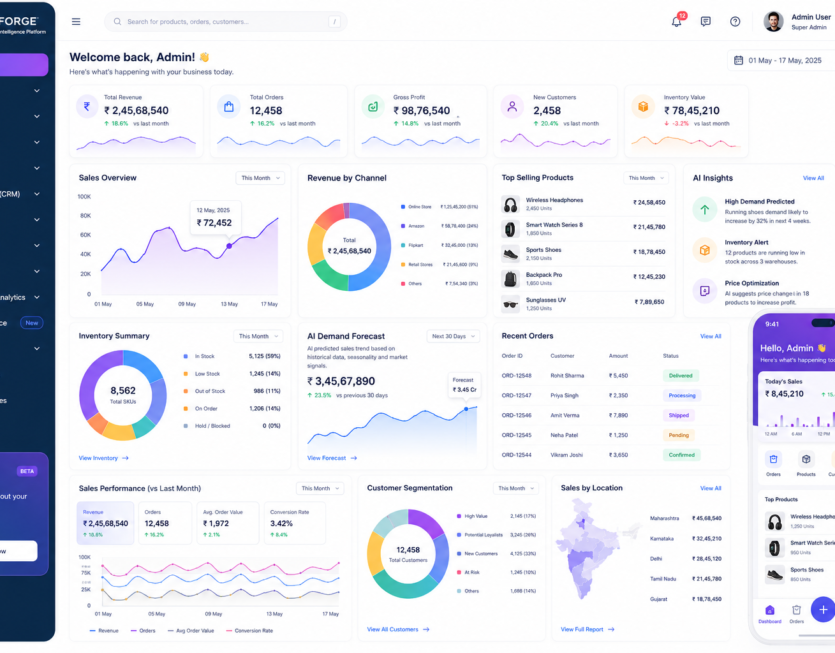
Executives accessed a centralized AI-powered dashboard providing a complete 360-degree view of business performance.
Instead of manually reviewing dozens of reports, leadership teams could monitor:
- Live Sales Performance
- Revenue Growth
- Profit Margins
- Inventory Health
- Customer Acquisition
- Customer Lifetime Value
- Warehouse Performance
- Supplier Reliability
- Employee Productivity
- Marketing ROI
- Financial Forecasts
- Cash Flow Analysis
Interactive dashboards were supported by conversational AI, allowing executives to ask natural language questions such as:
“Why did sales decrease this week?”
“Which products generated the highest profit this quarter?”
“How much revenue is at risk due to inventory shortages?”
“Which suppliers should we renegotiate with?”
The AI generated instant analytical responses backed by real business data.
Omnichannel Commerce Integration
The platform synchronized operations across multiple sales channels including physical retail stores, distributors, wholesalers, online marketplaces, eCommerce websites, and mobile applications.
Inventory remained synchronized in real time across every channel while customer data, pricing, promotions, and orders were managed through a single centralized platform.
This enabled businesses to scale efficiently while maintaining consistent customer experiences regardless of where purchases originated.
Scalability & Enterprise Architecture
The platform was engineered using a modular architecture capable of supporting businesses ranging from growing startups to multinational enterprises.
Support included:
- Multi-Company Operations
- Multi-Branch Management
- Multi-Warehouse Architecture
- Multi-Currency Transactions
- Multi-Language Support
- Role-Based Access Control
- API Integrations
- Cloud Deployment
- Hybrid Infrastructure
- High Availability
- Enterprise Security
- Audit & Compliance Management
Business Impact
The AI Commerce Intelligence Platform transformed fragmented retail and eCommerce operations into a unified intelligent enterprise.
By combining ERP, CRM, Artificial Intelligence, Business Intelligence, Machine Learning, and predictive analytics into a single ecosystem, organizations gained complete operational visibility, optimized inventory investment, improved customer engagement, increased sales productivity, reduced operational costs, and made faster strategic decisions driven by real-time intelligence.
Rather than serving as a conventional ERP, the platform became the organization’s digital operating system—continuously learning from every transaction, predicting future business trends, and recommending actions that increased profitability and long-term growth.
Core Technologies
Enterprise Applications
- Enterprise Resource Planning (ERP)
- Customer Relationship Management (CRM)
- Warehouse Management System (WMS)
- Procurement & Supply Chain Management
- Finance & Accounting
- Human Resource Management
- Marketing Automation
- Customer Support Platform
Artificial Intelligence
- Machine Learning
- Predictive Sales Forecasting
- AI Recommendation Engine
- Customer Segmentation
- Demand Forecasting
- Revenue Leakage Detection
- Churn Prediction
- Dynamic Pricing Intelligence
- Conversational Executive AI
Business Intelligence
- Executive Dashboards
- KPI Analytics
- Financial Reporting
- Profitability Analysis
- Operational Intelligence
- Sales Performance Analytics
- Customer Insights
- Inventory Intelligence
Integrations
- Payment Gateways
- Logistics & Courier APIs
- Accounting Systems
- POS Systems
- Marketplace APIs
- REST APIs
- Cloud Infrastructure
- Mobile & Web Applications