
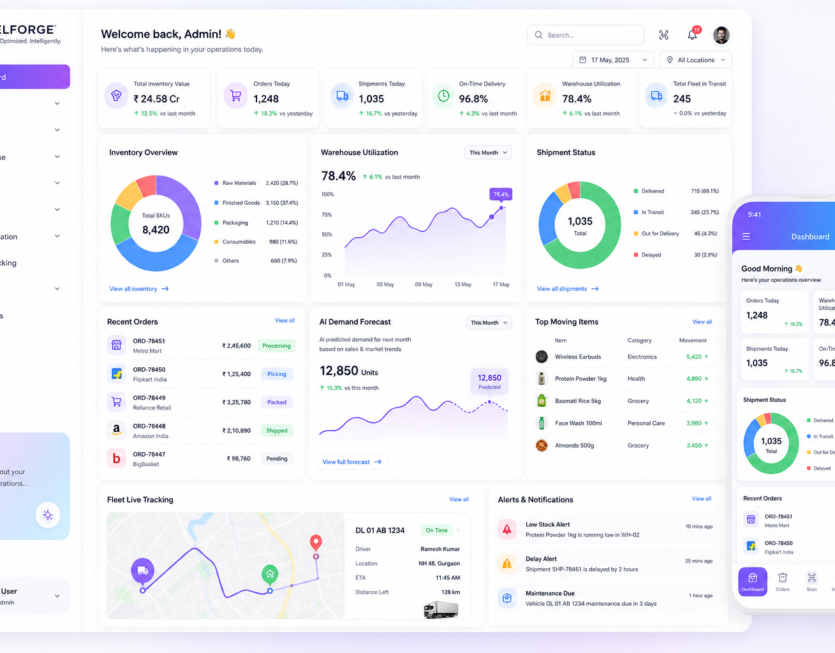
AI Inventory Intelligence, Smart Warehousing & Autonomous Logistics Operations
Project Overview
A rapidly expanding warehousing and logistics enterprise managing multiple distribution centers, transportation hubs, and regional warehouses was facing increasing operational complexity due to disconnected inventory systems, manual warehouse processes, limited shipment visibility, inefficient storage utilization, and rising logistics costs. As order volumes continued to grow across both B2B and eCommerce channels, maintaining inventory accuracy, optimizing warehouse operations, and ensuring timely deliveries became increasingly challenging.
Warehouse operators relied heavily on spreadsheets and fragmented software platforms to manage inventory movement, order fulfillment, procurement, dispatch planning, and transportation tracking. Inventory discrepancies, delayed shipments, inefficient picking routes, excess stock, stock shortages, and poor warehouse space utilization directly impacted operational efficiency and customer satisfaction. Management lacked a centralized system capable of providing real-time visibility into warehouse operations, fleet movements, inventory health, and logistics performance across multiple facilities.
Intelforge partnered with the organization to design and develop a next-generation Intelligent Warehouse & Logistics Management Ecosystem that transformed traditional warehouse operations into a fully connected, AI-driven digital infrastructure. The objective was to create a centralized platform where inventory, warehouses, transportation, procurement, suppliers, customers, and field operations could communicate seamlessly while Artificial Intelligence continuously optimized operational performance.
The solution integrated Warehouse Management (WMS), Enterprise Resource Planning (ERP), Transportation Management (TMS), Inventory Management, Procurement, Fleet Monitoring, Customer Orders, Finance, and Business Intelligence into one intelligent platform. Simultaneously, barcode scanners, RFID readers, handheld terminals, industrial weighing systems, IoT gateways, GPS-enabled vehicles, smart shelving, automated storage systems, and warehouse sensors were connected into a unified operational ecosystem.
Every inventory movement—from receiving raw materials to storage allocation, picking, packing, dispatch, transportation, and final delivery—was captured automatically in real time. Warehouse managers gained complete operational visibility through live dashboards displaying inventory levels, warehouse utilization, shipment status, vehicle tracking, workforce productivity, and order fulfillment performance without relying on manual reporting.
AI-Powered Inventory Intelligence
Rather than functioning as a conventional Warehouse Management System, the platform continuously learned from operational data using Artificial Intelligence and Machine Learning.
Historical inventory movements, seasonal demand, supplier lead times, customer purchasing behaviour, warehouse utilization, transportation performance, and sales trends were analyzed continuously to predict future inventory requirements with remarkable accuracy.
The AI engine proactively answered critical operational questions before they became business problems.
- Which products are likely to become out of stock next week?
- Which warehouse will exceed storage capacity next month?
- Which inventory items are becoming slow-moving assets?
- Which suppliers consistently delay deliveries?
- Which products should be redistributed between warehouses?
- Which transportation routes increase delivery costs?
- Which customers are likely to generate sudden demand spikes?
- Which warehouse operations are creating fulfillment bottlenecks?
Instead of reacting to inventory shortages or excess stock, management received predictive recommendations allowing proactive planning and significantly reducing working capital tied up in inventory.
Intelligent Warehouse Automation
Every warehouse operation was digitally orchestrated through intelligent automation.
As inventory entered the warehouse, AI evaluated product dimensions, weight, demand frequency, storage constraints, warehouse occupancy, picking history, and dispatch schedules before automatically recommending the most efficient storage location.
The system continuously optimized:
- Put-away operations
- Rack allocation
- Bin management
- FIFO / FEFO inventory rotation
- Batch and serial tracking
- Cross-docking
- Multi-warehouse inventory balancing
- Order prioritization
- Pick-path optimization
- Packing workflows
Warehouse associates received optimized picking routes directly on handheld devices, minimizing unnecessary walking distance while increasing picking accuracy and operational throughput.
The result was faster order processing, improved warehouse utilization, and significantly lower labor costs.
Predictive Logistics & Fleet Intelligence
Transportation operations became completely data-driven through AI-powered logistics optimization.
GPS-enabled fleet vehicles continuously transmitted live location, fuel consumption, driver behaviour, route deviations, idle time, vehicle utilization, delivery progress, and estimated arrival times.
Artificial Intelligence analyzed weather conditions, traffic congestion, historical delivery performance, customer delivery windows, and transportation costs to automatically recommend the most efficient delivery routes.
Dispatch teams could simulate multiple transportation plans before assigning vehicles, ensuring maximum fleet utilization while minimizing fuel costs and delivery delays.
The platform also monitored vehicle health and maintenance schedules, predicting service requirements before unexpected breakdowns interrupted logistics operations.
Digital Warehouse Twin
One of the platform’s most advanced capabilities was the Digital Warehouse Twin.
Using live operational data, Intelforge created a virtual replica of every warehouse where management could simulate operational changes before implementing them physically.
Executives could evaluate questions such as:
- What happens if warehouse capacity increases by 30%?
- Which storage configuration minimizes picking time?
- How many workers are required during seasonal demand?
- What is the financial impact of opening another warehouse?
- How should inventory be redistributed during demand fluctuations?
The Digital Twin enabled data-driven strategic planning while reducing investment risks associated with warehouse expansion and operational redesign.
Business Intelligence & Executive Decision Platform
Operational data from warehousing, transportation, procurement, inventory, finance, suppliers, sales, and customer orders was consolidated into a centralized Executive Intelligence Dashboard.
Instead of generating static reports, Artificial Intelligence continuously interpreted operational data and delivered executive recommendations such as:
- Reduce inventory of Product A by 18% to release working capital.
- Transfer excess inventory from Warehouse B to Warehouse D before projected shortages occur.
- Replace Supplier X due to declining delivery reliability.
- Increase vehicle allocation for Route 5 based on forecasted order volume.
- Expand storage capacity in Distribution Center 3 within the next 45 days.
Executives no longer spent hours analyzing spreadsheets. Critical operational decisions were supported by AI-driven insights generated automatically in real time.
Revenue Leakage Detection
The platform continuously searched for hidden operational inefficiencies affecting profitability.
Artificial Intelligence identified:
- Inventory shrinkage
- Excess warehouse handling costs
- Inefficient storage allocation
- High transportation expenses
- Delayed dispatch operations
- Idle warehouse resources
- Underutilized fleet vehicles
- Slow-moving inventory
- Repeated picking errors
- Procurement inefficiencies
Each issue was prioritized according to its financial impact, enabling management to recover revenue that would otherwise remain unnoticed.
Scalability & Future Readiness
The architecture was designed to support enterprise-scale operations across multiple warehouses, fulfillment centers, manufacturing facilities, transportation networks, and international distribution hubs.
Whether managing ten thousand inventory items or several million, the platform maintained high performance while supporting cloud deployment, hybrid infrastructure, multi-company operations, role-based security, API integrations, IoT expansion, robotics, automated storage systems (ASRS), autonomous mobile robots (AMRs), and future AI capabilities.
Business Impact
The Intelligent Warehouse & Logistics Management Ecosystem transformed conventional warehouse operations into a connected, data-driven enterprise powered by Artificial Intelligence. Organizations gained complete visibility across inventory, logistics, procurement, and transportation while dramatically improving warehouse productivity, inventory accuracy, fleet utilization, customer service, and executive decision-making.
Rather than simply managing inventory, the platform continuously optimized operations, predicted future challenges, recommended business improvements, and enabled organizations to scale efficiently with confidence.
Core Technologies
Enterprise Systems
- Warehouse Management System (WMS)
- Transportation Management System (TMS)
- Enterprise Resource Planning (ERP)
- Inventory & Procurement Management
- Fleet Management Platform
- Business Intelligence Dashboard
Industrial & IoT Integration
- RFID & Barcode Scanning
- IoT Gateways
- GPS Vehicle Tracking
- Smart Warehouse Sensors
- Digital Weighing Systems
- Automated Storage & Retrieval System (ASRS)
- Handheld Warehouse Devices
Artificial Intelligence
- Inventory Forecasting
- Demand Prediction
- AI Route Optimization
- Warehouse Digital Twin
- Revenue Leakage Detection
- Predictive Logistics
- Predictive Maintenance
- Executive AI Assistant
- Machine Learning Analytics
Technology Stack
- Cloud Infrastructure
- REST API Integrations
- Real-Time Data Streaming
- Android Applications
- Web Portal
- Desktop Applications
- Enterprise Security
- Multi-Warehouse & Multi-Company Architecture